















Blog Article
Here's how it works: A booking agency as an example of smart app usage
Let's Get Started! – Digital Transformation Made Easy, Part II
Inthe first part of our series, we set the stage for digital transformation: Which digital structures can and should I use for my business model, and which work processes and methods can I adapt flexibly?
Those who haven’t yet fully grappled with this can quickly get overwhelmed, as all areas of work are affected. Nevertheless, it’s important to stay calm and proceed step by step. We’d like to support you in this process.
Communication Channel No. 1: Reach Any Target Audience with a Smartphone
The focus of this series is initially on external and internal communication: How, where, and when do I reach my customers, partners, and colleagues? How can the flow of information be optimized, paths shortened, and benefits increased?
With your own app as a touchpoint, these issues can be effectively addressed: The smartphone, as a constant companion, is always at hand; information is accessible without a browser search or many clicks; and the user experience is intuitive and inviting.
And the best part: Anyone can create their own app today! No expensive programmers, licenses, or software, no tedious development process, and no complicated user manuals.
Let’s get down to business: Here’s how to build your own app
In the first post of this series, we outlined the steps to creating your own app: plan, generate buzz, build, design, and launch. What sounds so simple is just as easy in reality! We’d like to illustrate this with concrete examples and make getting started even easier for you.
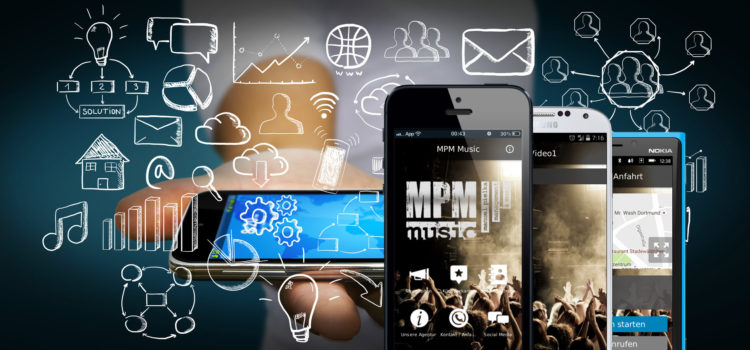
Let’s take MPM Music as our first example, a major booking agency specializing in chart hits, Schlager music, and 90s acts. Here, event organizers can book stars and artists from TV and the press for their events.
The Planning: What target audiences, features, and content do we need?
To make access easier for its primary partners as well as anyone generally interested, and to provide them with the company’s portfolio and the latest news quickly and easily, the company decided to create its own app.
There, the entire roster of stars is directly viewable by customers. This allows them to quickly see who is available when and to submit a non-binding inquiry even while on the go.
At the same time, the app is intended to support presentations and research during sales meetings: Agency staff can access all relevant data on-site with just a few clicks and present it to the client in an engaging format.
In addition, the company plans to implement a secure area within its app where terms, costs, and similar information are securely integrated.
The Buzz: Generating as Much Attention as Possible Even Before Launch
The booking agency MPM Music has used its existing channels—both digital and analog—to inform its clients about this new service. The app is announced in the newsletter and on the websites with images and information, and its initial features are described.
But that’s not all: Employees also use face-to-face communication with customers and partners to discuss the benefits in direct conversation, such as the ability to quickly and easily access limited availability slots and exclusive early-bird promotions.
The Development: What Service Do Our Customers Need?
During development, the booking agency clearly decided that two aspects are particularly important and must be available from the start: an overview of the booking roster for all stars and the option to make a direct inquiry. Because that’s exactly what customers want: find quickly, book easily.
With a clear sorting system modeled after the layout on the websites, they can select a category—e.g., charts or pop music—and immediately access the list of artists in that genre.
In addition to information, videos of the stars are also included here, so that interested parties can literally get a picture of them.
In addition, customers can specify their preferred date and venue. This way, the agency receives all the initial relevant data and can respond quickly to inquiries.
Your Design, Your Branding: This Is How Your Clients Feel Right at Home
This step was quite straightforward for the booking agency: As is the case with many companies, the corporate design was already in place. Colors, style, and structure were implemented in line with the website, and the company logo was integrated.
At the same time, the agency placed great emphasis on ensuring that the interface is intuitive and that customers know immediately where to find everything, even on their first use.
Ready, set, go! The test runs are successful
MPM Music has already launched test runs in small circles and has received only positive feedback so far: functionality, design, and usability have been very well received. After just a few weeks of planning and preparation, we’re ready to go!
As you can see, it’s not difficult at all to create your own app with the features that matter to you and your customers. To show you the full range of benefits and uses of apps, we’ll be featuring a school’s app in our next post. In this case, we had to incorporate entirely different content and features to reach the target audiences of students, teachers, and parents.
At the same time, we’d like to delve a little deeper into the topic of pre-sales.
Treat your app like a valuable product!
In this series, we’ll embed your app into a simplified model of pre-sales, sales, and post-sales phases to address these topics individually. This may sound a lot like sales, but it simply means that your app can be integrated as a key component alongside phone, email, and other channels throughout the entire sales process and follow-up support.
There are many approaches to pre-sales, and not all of them need to be implemented immediately or perfectly. The fact is, however: when integrated, they have an immediate positive impact on your public image.
In pre-sales, people search and find
The goal is to draw the attention of existing and potential customers to the app and showcase its benefits. Whether via social media, over the phone, or in face-to-face conversations: what matters is that you gently but consistently encourage your customers to use the app—you have plenty of reasons to do so!
Since every business deals with different processes, in the next post we’ll start by providing generalized approaches and solutions. With a little creativity and further inspiration from best-practice examples, however, you can easily adapt these to your specific needs.
Do you have specific channels, target audiences, or products that you’d like us to discuss in relation to app usage? Are you unsure whether this could work for your business? Let us know—we look forward to hearing from you!